
Africa’s Satellite Internet Battle: Who Will Win: Amazon Leo vs Starlink?
By WISPGate | Built for Modern ISPs
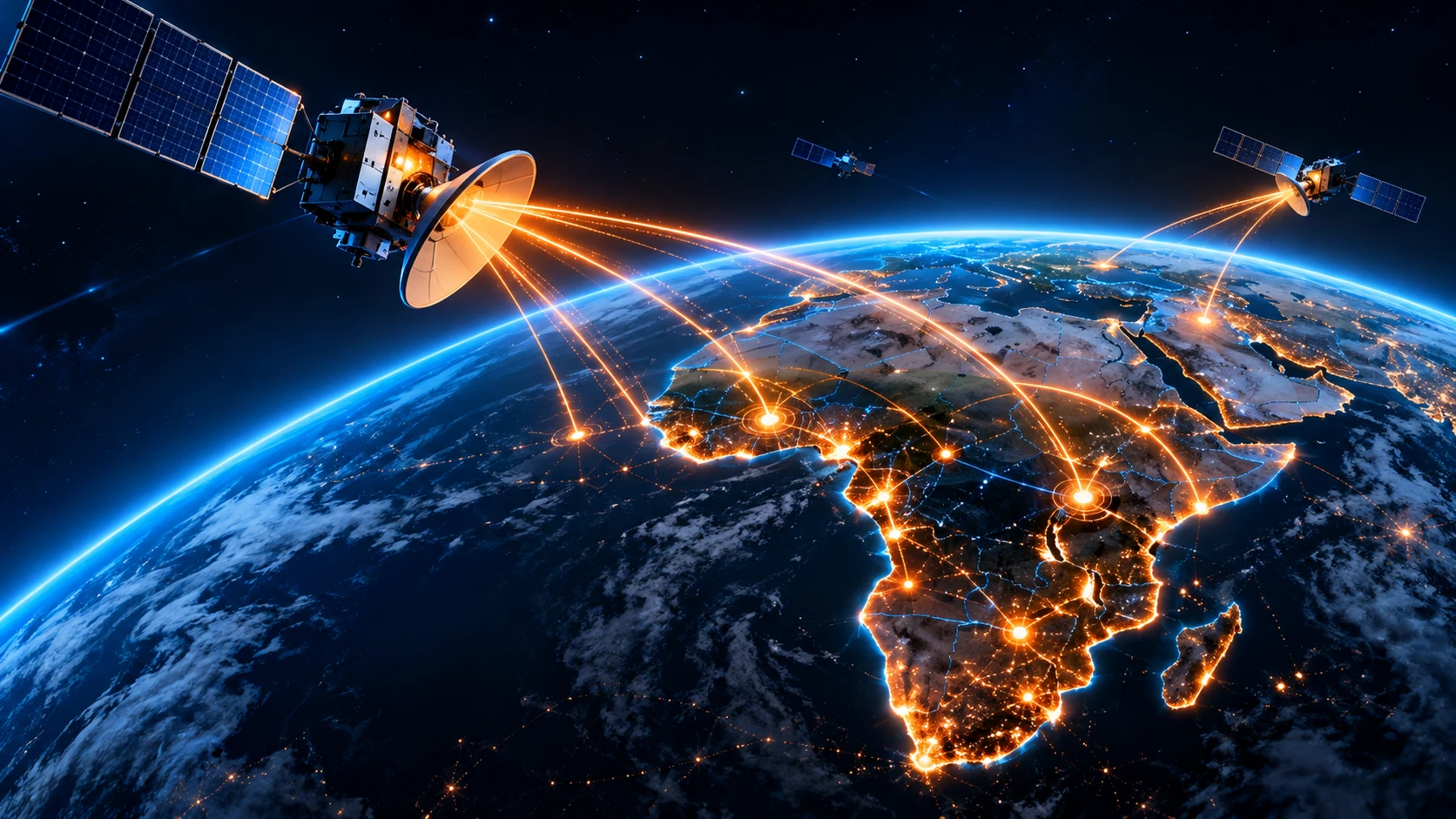
Elon Musk’s Starlink already sells satellite internet in African markets that Amazon is still preparing to enter. Amazon, founded by Jeff Bezos, is challenging that lead with Amazon Leo and agreements involving Herotel, Vodafone and Vodacom. The contest is over permission to operate, customers who can afford the service and contracts with African telecom operators.
Amazon Leo was previously called Project Kuiper; the name changed in November 2025. It is an Amazon business, separate from Bezos’s Blue Origin. Both Leo and Starlink use low-Earth-orbit satellites. Their African strategies overlap, but their progress is far from equal. [1, 4]
Why Africa matters to Amazon and Starlink
The International Telecommunication Union estimates that 36% of people in its Africa region used the internet in 2025, compared with 74% globally. That regional grouping excludes several North African countries, so the figure should not be mistaken for a whole-continent measure. [2]
For Amazon and Starlink, the opportunity includes rural homes, farms and businesses beyond reliable fibre or mobile coverage. It also includes selling satellite capacity to telecom operators extending their networks. But people being offline does not automatically make them paying satellite customers: equipment and subscription costs still determine who can connect.
Starlink has the head start in African markets
Starlink began serving Nigeria in January 2023, its first African market. By May 2025, SpaceX said the service was available in more than 20 African markets. Amazon began deploying its production constellation in April 2025 and opened an enterprise preview that November. [3, 4, 16, 1]
The difference in scale was substantial: Reuters reported on 2 July 2026 that Amazon had deployed more than 390 satellites, against roughly 10,000 operated by Starlink. That is a dated snapshot, not today’s fleet count. It explains why Amazon is still building coverage while Starlink already has years of African customer experience. [5]
South Africa gives Amazon a route around Starlink’s licensing impasse
In Musk’s birth country, national licensing rules have constrained Starlink’s entry. In May 2026, regulator ICASA reaffirmed a minimum 30% ownership requirement for historically disadvantaged groups for individual licence holders. Reuters reported in July that Starlink was awaiting proposed changes allowing alternatives to equity stakes. [6, 7]
Amazon chose an existing local provider. Its July agreement with Herotel targets a 2027 launch under the name evry. Amazon supplies the satellite network; Herotel brings local installation and support. At the announcement, Herotel served more than 350,000 customers across over 550 towns and operated 120 offices. Those are existing fibre and wireless customers, not Amazon satellite subscribers. [8]
The deal gives Amazon a defined route into the market, but it is not a completed regulatory victory. ICASA told MyBroadband in July that Herotel already held network and service licences but still needed relevant radio-frequency spectrum licences. Herotel’s current evry page continues to target 2027. [9, 14]
Nigeria shows the difference between a permit and a launch
Nigeria is already part of Starlink’s commercial footprint. Amazon’s Kuiper Systems holds a seven-year landing permit running from 28 February 2026 to 28 February 2033, according to the Nigerian Communications Commission. [3, 10]
The permit allows satellite signals over Nigeria. The NCC explicitly says this permission alone does not authorise direct service to end users; service must pass through appropriately licensed ground operators. Amazon has secured an important approval, but that record does not establish that a Nigerian household can order Amazon Leo today. [10]
Kenya is a contest for ground infrastructure as well as customers
Starlink entered Kenya in July 2023. Amazon is preparing its own presence: Business Daily reported in June 2026 that Amazon Kuiper Kenya had applied for a 15-year international gateway licence for a satellite ground station. An application is not confirmation that the gateway is operating. [11]
A gateway connects a satellite network to terrestrial internet infrastructure. Amazon describes these facilities as one of the three essential parts of Leo, alongside satellites and customer terminals. The Kenyan proposal therefore concerns the infrastructure Amazon needs to compete, not simply another country added to a coverage map. [1]
Vodacom and Airtel are part of the competition
Amazon’s agreement with Vodafone covers links between remote 4G and 5G base stations and the operator’s core network. Deployment is planned first in Europe, then in Africa through Vodacom. This is mobile backhaul: the phone connects to a tower, and the satellite carries the tower’s traffic onward. [12]
Starlink is pursuing operator partnerships too. Airtel Africa’s May 2025 agreement with SpaceX covered connectivity for businesses, schools and health centres, and exploration of cellular backhaul. Describing Amazon as the partner-friendly company and Starlink as exclusively direct-to-consumer would miss this part of the rivalry. [4]
For either satellite provider, an operator agreement creates a way to reach users who may never buy a household dish. The competition includes contracts with African telecom companies as well as individual broadband subscriptions.
Starlink Mobile has already reached commercial launch in the DRC
In an announcement dated 17 August 2026, Airtel Africa reported the commercial launch of Starlink Mobile in the Democratic Republic of the Congo, following tests in Kenya. Compatible LTE Android phones can use SMS and light-data applications, including WhatsApp messaging, outside terrestrial coverage with a clear view of the sky. [13]
This direct-to-cell service differs from Amazon’s announced Vodafone tower-backhaul arrangement: the phone connects to the satellite itself. The DRC launch does not establish continent-wide availability or household-broadband speeds. It does show that Starlink’s African expansion now extends beyond dish-based internet. [13]
Amazon’s African prices remain unconfirmed
Herotel advertises evry’s Nano terminal at up to 100 Mbps and Pro at up to 300 Mbps. Its CEO has described plans for prices close to Herotel’s fibre offers and options to finance the terminal. The reviewed evry page does not publish final tariffs. There is no confirmed South African price comparison that proves Amazon cheaper than Starlink. [14, 15]
Even the speed figures need context. Amazon’s global Leo page advertises Pro at up to 400 Mbps, while Herotel’s South African page lists 300 Mbps. A global hardware specification is not the same as the local service offer, and neither is an independent test of performance during busy hours. [1, 14]
For Amazon to turn African interest into subscriptions, its eventual local prices and delivered performance must justify choosing it over the connections customers can already buy.
SpaceX is also launching Amazon’s satellites
The Musk–Bezos rivalry contains a commercial overlap: Amazon buys launches from SpaceX. On 16 July 2025, a Falcon 9 carried 24 Amazon satellites into orbit. Amazon also uses other launch providers. [16]
That matters to Africa because Amazon’s expansion depends on getting enough satellites into service. Musk’s company can earn launch revenue while helping deploy the network that will compete with Starlink.
Who is ahead in the battle for Africa’s internet
Starlink leads in delivered service: it entered African markets years earlier and now has an announced commercial satellite-to-phone deployment through Airtel. Amazon’s challenge is concrete but less mature: Herotel in South Africa, a Nigerian landing permit, a proposed Kenyan gateway and the Vodafone–Vodacom agreement.
Amazon can compete for households through local ISPs and for capacity contracts through mobile operators. To take customers from Starlink, it must turn those arrangements into available service at a compelling price. South Africa will be an important test: can Amazon and Herotel deliver evry in 2027, and what Starlink offer will they face when they do?
WISPGate’s experience with African ISPs
Africa is an established part of WISPGate’s business. We work directly with African internet service providers, supporting the billing, subscriber management and daily operations behind their networks. These customer relationships give us firsthand experience of the practical demands of running an ISP in African markets. As Amazon Leo and Starlink expand their presence, we bring that operator perspective to the discussion: what these changes mean for the local providers already connecting communities and serving customers.
Sources
Numbered references correspond to the article. Company statements establish announced plans and product claims; they are not independent performance tests.
- Amazon – Amazon Leo explained and the Project Kuiper name change
- ITU – Internet use in 2025
- TheCable – Starlink launches in Nigeria, January 2023
- Airtel Africa – Starlink connectivity agreement, May 2025
- Reuters – Amazon approaches 400 satellites, July 2026
- ICASA – Ownership requirements and proposed alternatives, May 2026
- Reuters – Amazon and Herotel announcement, July 2026
- Amazon – Herotel partnership and existing customer footprint
- MyBroadband – ICASA explains Herotel’s remaining requirements
- NCC – Kuiper landing permit and its scope
- Business Daily – Amazon’s Kenyan gateway application, June 2026
- Vodafone – Amazon Leo agreement for Europe and Africa
- Airtel Africa – Commercial Starlink Mobile launch in the DRC
- Herotel – evry speeds and 2027 launch target
- TechCentral – Herotel’s pricing intentions and financing plans
- Amazon – Mission log including the July 2025 Falcon 9 launch
Ready to Build a Smarter ISP?
Automate billing, streamline customer management, connect operational workflows, and gain greater visibility across your business.
Schedule a Live Demo →